Live-cell density
—
Share of all cells that are live.
Final row: —SIMPLE SYSTEMS / STRANGE BEHAVIOR
Three neighbors. Two possible states.
Watch a single rule become a world.
4,096 recorded experiments
Change one assumption, track a perturbation, and export the evidence.
02 / UNDERSTAND Follow the questions.Six guided investigations, primary sources, and a classroom route.
03 / BROWSE Inspect the corpus.4,096 stored experiments, with complete trajectories and measurements.
Loading the observation…
CHOOSE A RULE
One live cell at the center of an empty world.
Three cells above decide the next cell below.
Checking for an exact repeated state.
—
Share of all cells that are live.
Final row: ——
Share of cells changing between successive rows.
Across 128 transitions—
Mean difference after toggling the central starting cell.
Final row: ——
Binary Shannon entropy of the live/dead balance.
Balance, not complexity—
Compressed bytes divided by packed trajectory bytes.
zlib, level 9 · a heuristicFIND A DIFFERENT WORLD
Order gives way to repetition, motion, and surprise.
Select a specimen to open its recorded experiment.
MAKE THE CONNECTION PRECISE
A useful model gives us a controlled question. The next step is to distinguish what it demonstrates from what the wider world still asks us to measure.
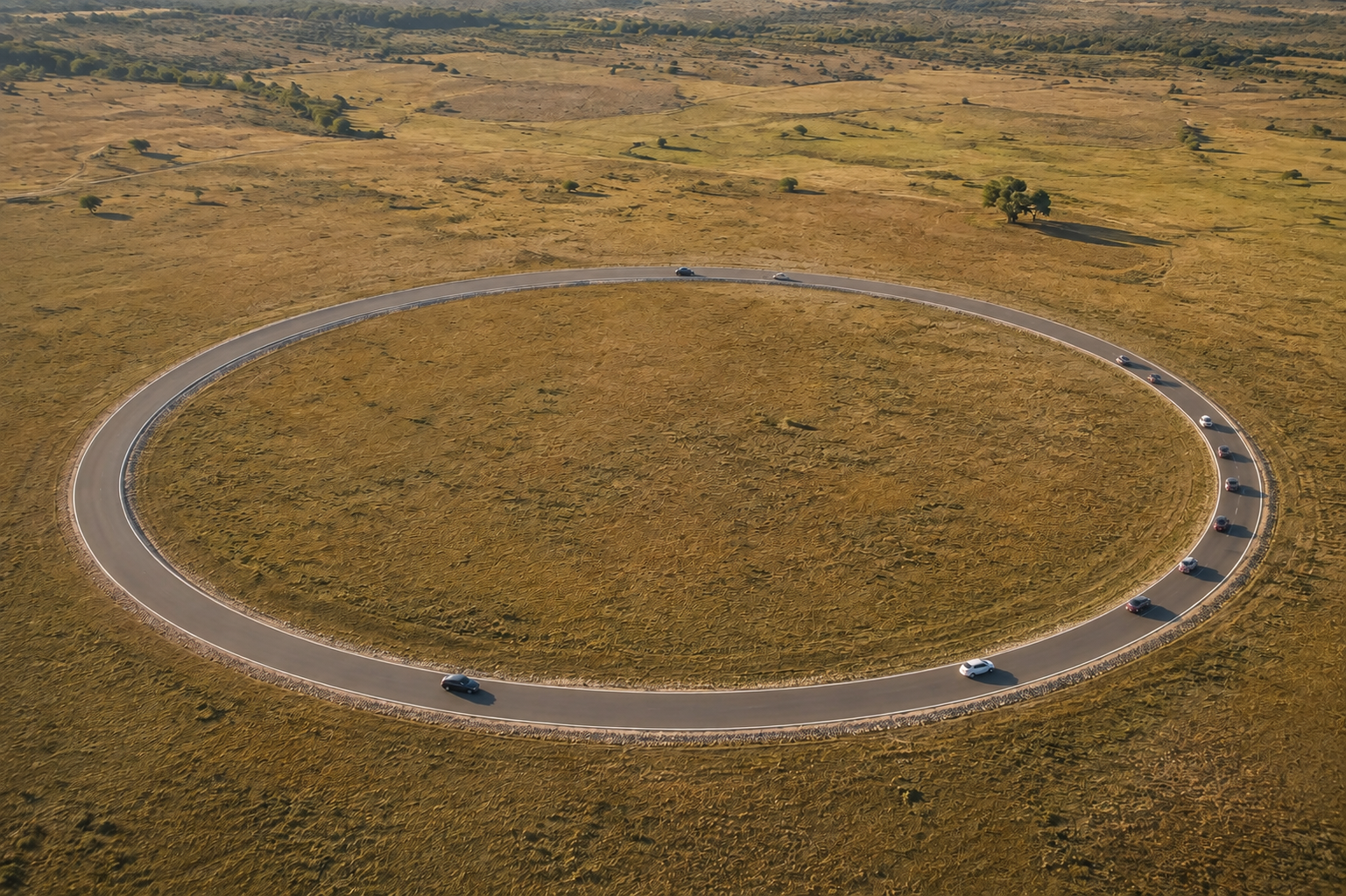
RULE 184 / TRANSPORT
Set the density of a closed road. Count the cars that move, watch queues form, and compare the observed flow with the model’s long-run prediction.
Investigate traffic flow
PATTERN / EXPLANATION
Natural patterns can suggest local mechanisms. Learn why a convincing visual match still needs a model of the process, measurements, and a test that could prove it wrong.
Read the field investigationA LITTLE CONTEXT
Generated computational experiments; one record per parameter combination.
Each of 128 cells is on or off. Its next state depends on itself and its two neighbors. The eight possible neighborhoods give us 256 rules. We record 128 updates, plus the initial row, for each rule, starting state, and boundary.
Every observation is a stored trajectory with a SHA-256 digest. Random starting states use a fixed xorshift32 seed; sparse, balanced, and dense states are deliberately nested. Catalog previews run the same rule locally. The main window displays the stored rows.
Occupancy entropy measures live/dead balance, not algorithmic complexity. Compression is a descriptive heuristic that depends on the zlib implementation. Perturbation compares a run with another whose central starting cell is toggled.
A detected cycle is an exact repetition of a full state in this finite deterministic system. “No cycle observed” only covers these 128 updates. It does not rule out a later cycle.